AQA Master
Part 1: Introduction
Key Definitions
Technological Innovation – The introduction of new production methods, processes or products that improve efficiency or create new market opportunities.
Dynamic Efficiency – Improvements in productive efficiency over time, often driven by investment, research and development, and innovation, leading to lower long-run average costs and better products.
Context Framing
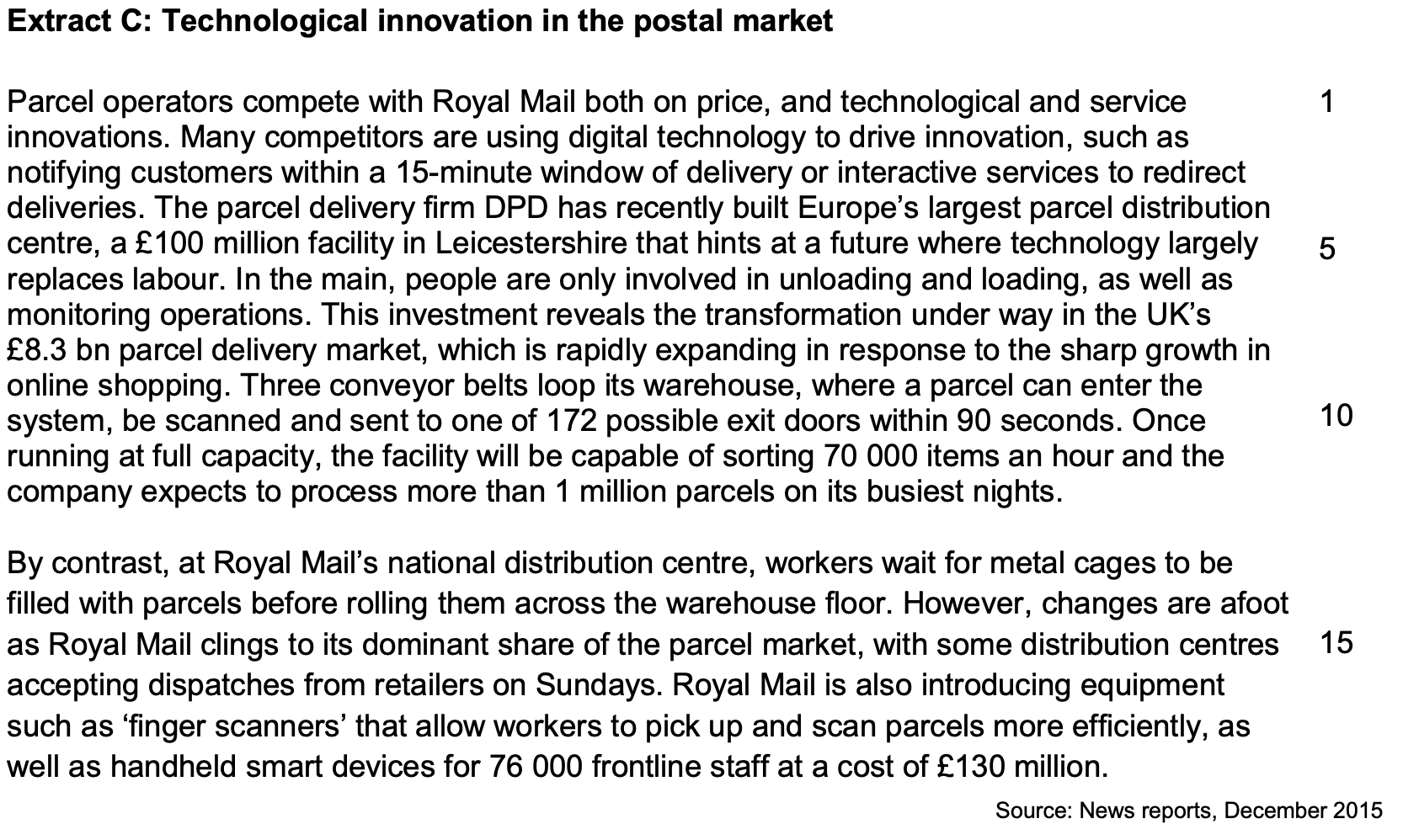
The UK parcel delivery market is valued at £8.3 billion and is expanding rapidly due to growth in online shopping. The extract highlights a transformational investment race, with firms like DPD investing £100 million in automation and Royal Mail spending £130 million on new devices for staff. This analysis will assess the microeconomic impacts on efficiency, costs, market structure, and consumer welfare.
Part 2: Analytical Sections
Section 1: Technological Innovation Driving Dynamic Efficiency & Competitive Advantage
Theory
Dynamic efficiency occurs when firms invest in innovation to lower their long-run average costs (LRAC) and improve product quality over time. It is a key feature of contestable and competitive markets where firms must innovate to survive.
Chain of Reasoning
Intense competition in the parcel market → firms like DPD seek a competitive advantage not just on price but on service quality → investment in automation (e.g., £100m distribution centre) represents process innovation → this new capital increases the capital-to-labour ratio → the marginal product of capital rises and unit handling costs fall → the firm’s LRAC curve shifts downwards → this grants DPD a temporary cost advantage, allowing it to offer lower prices or superior service (e.g., 15-minute delivery windows) → this forces rivals like Royal Mail to respond with their own innovations (e.g., finger scanners) to maintain market share → the market becomes more dynamically efficient over time.
Example from Extract
DPD’s automated centre can sort 70,000 items per hour and process over 1 million parcels on busy nights, a huge increase in capacity and speed compared to manual systems.
Diagram + Analysis
Diagram – Process Innovation (Shifting LRAC)
📊 See diagram: EconomicsHelp — Diagrams of Cost Curves
Axis labels: Vertical = Costs (£); Horizontal = Output (Q)
Key curves/lines: LRAC₁ (original), LRAC₂ (after innovation)
Shift/movement: LRAC₁ shifts down to LRAC₂ across all output levels.
New equilibrium: At any given output (e.g., Q₁), average cost falls from C₁ to C₂.
Economic outcome: DPD’s investment in automation is a process innovation that reduces its long-run average costs → LRAC shifts from LRAC₁ to LRAC₂ → this improves its productive potential and can lead to lower prices for consumers.
Evaluation
High fixed costs: The £100 million investment by DPD creates massive sunk costs. This high barrier to entry could paradoxically reduce contestability in the long run, protecting large incumbent firms from new competitors who cannot afford similar technology.
Time lags: The benefits of dynamic efficiency are long-term. In the short run, such investments can strain cash flow, as noted in the context where Royal Mail’s management may “find it harder… to find cash for investments”, potentially weakening its competitive response.
Section 2: Impact on Costs, Productive Efficiency & the Labour Market
Theory
Productive efficiency is achieved when production occurs at the lowest point on the average cost (AC) curve (min ATC). Technological innovation often displaces labour (labour-saving capital), altering the factor mix and the demand for different skill sets.
Chain of Reasoning
Automation technology (e.g., conveyor belts, automated sorting) → replaces routine manual labour (the extract notes “technology largely replaces labour”) → this increases the capital-to-labour ratio for firms → variable costs per parcel fall as machines handle high volumes (70,000 items/hour) → the firm’s short-run average total cost (SRATC) curve shifts downwards and its minimum efficient scale (MES) may increase → the firm moves closer to productive efficiency. However, this reduces derived demand for low-skilled warehouse labour → could increase structural unemployment in the absence of retraining → this is a significant social cost, with the Communication Workers Union likely to “fight any redundancies”.
Example from Extract
At Royal Mail’s traditional centre, workers manually roll cages, a labour-intensive process. Their investment in ‘finger scanners’ aims to improve labour productivity, making existing workers more efficient rather than immediately replacing them.
Diagram + Analysis
Diagram – Shifts in Short-Run Cost Curves
📊 See diagram: EconomicsHelp — Diagrams of Cost Curves
Axis labels: Vertical = Costs (£); Horizontal = Output (Q)
Key curves/lines: SRATC₁ (original), SRATC₂ (post-innovation), MC₁, MC₂
Shift/movement: Both SRATC and MC shift downwards to SRATC₂ and MC₂.
New equilibrium: The cost of producing any level of output falls. The profit-maximising output (where MR=MC) occurs at a lower cost.
Economic outcome: Adoption of technology reduces both variable and average total costs → SRATC shifts from SRATC₁ to SRATC₂ → this increases productive efficiency, allowing firms to lower prices or increase profit margins.
Evaluation
Skill bias: The new technology increases demand for high-skilled workers (e.g., technicians, IT support) while reducing demand for low-skilled manual labour. This can exacerbate wage inequality within the economy, a significant microeconomic drawback.
Potential for higher quality: The impact isn’t solely on costs. Innovations like real-time tracking and re-direction services improve service quality and consumer utility, which may justify a price premium and lead to a net welfare gain beyond simple efficiency measures.
Section 3: Market Structure, Conduct & Performance
Theory
The structure of a market (number of firms, barriers to entry) influences firm conduct (pricing, investment) and ultimately economic performance (efficiency, innovation). The parcel market appears oligopolistic, with Royal Mail holding a “dominant share” and competing with other large firms like DPD.
Chain of Reasoning
The market is expanding (£8.3bn, growing with online shopping) → attracts large-scale, game-changing investments from competitors like DPD → this increases sunk costs and capital requirements, raising barriers to entry → the market structure may become more concentrated. Firms engage in non-price competition through service innovation (e.g., delivery windows, Sunday collections) → this can be beneficial for consumers, increasing choice and quality. However, Royal Mail’s need to “cling to” its share while funding a £130m tech upgrade shows profit may be squeezed → this could limit future investment or lead to higher prices if the firm seeks to protect its profit margin.
Example from Extract
The extract explicitly states competition occurs on “technological and service innovations” as well as price, and contrasts DPD’s automated “future” with Royal Mail’s gradual adoption of new devices.
Diagram + Analysis
Diagram – Oligopolistic Interdependence (Kinked Demand Curve)
📊 See diagram: EconomicsHelp — Kinked Demand Curve
Axis labels: Vertical = Price/Cost (£); Horizontal = Quantity (Q)
Key curves/lines: Kinked AR (Demand) curve, MR curve with vertical discontinuity, MC₁, MC₂
Shift/movement: MC can shift within the MR discontinuity (from MC₁ to MC₂) without triggering a price change.
Economic outcome: In an oligopoly like parcels, firms may be reluctant to raise prices for fear of losing market share, but also reluctant to cut prices for fear of triggering a price war → this creates price rigidity. Competition is instead channelled into non-price areas like the technological innovation described in the extract.
Evaluation
Contestability vs. Concentration: While innovation is a sign of dynamic efficiency, the vast scale of investment required could make the market less contestable, shielding large incumbents. The net effect on long-term performance depends on whether the threat of entry remains credible.
Universal Service Obligation (USO): A key synoptic limitation is Royal Mail’s USO, which requires nationwide delivery six days a week. This imposes unique costs not faced by its competitors, potentially putting it at a disadvantage in the innovation race and distorting the level playing field.
Part 3: Final Judgement
In conclusion, the microeconomic impact of technological innovation in the parcel market is likely to be net positive, but with significant distributional consequences and risks. The strongest argument is the move towards dynamic and productive efficiency, as shown by DPD’s massive capacity gains and the industry-wide push for better service, which boosts consumer welfare and helps the market adapt to growing demand. The extract provides clear evidence of this transformative investment.
However, this judgement is heavily qualified. The benefits rely on the market remaining competitive enough to pass cost savings to consumers, rather than allowing increased concentration. Furthermore, the major counter-argument – the potential for technological unemployment and social resistance from unions – is substantial. Ultimately, the positive impact on efficiency and service quality will dominate provided that labour market policies (e.g., retraining) and competition policy are effective in mitigating the downsides. The evolution of this market will be a key case study in how oligopolistic firms balance innovation, cost, and competition.
Generated by EasyNomics, AI-generated, for reference only.