A* Essay Structure Evaluation Chains of Reasoning AD–AS Model Opportunity Cost Phillips Curve Market Failure Fiscal Policy PED / YED / XED Externalities Monetary Policy Ceteris Paribus Game Theory Trade-offs Lorenz Curve Comparative Advantage Exchange Rates LRAS / SRAS Globalisation Monopoly Supply-side Policies
ChatGPT doesn’t know your mark scheme. We do.

Stop Losing Marks on

We don’t write your essays. We teach you how to ace them. Examiner-approved structures, AI feedback on every scoring criterion, at a fraction of a tutor’s cost.

Start 3-Day Free Trial See how it works
Secure payments via Stripe · No auto-renewal
Supported Exam Boards
AQA A-Level Economics CIE A-Level Economics

The EasyNomics learning cycle.

We don’t write your essays. We help you become the student who writes A* essays.

1
Structure

Get an examiner-approved essay plan from EasyNomics

2
Write

Write the essay yourself, because that’s how real skill is built

3
Feedback

Get your teacher’s comments, then send it to our AI Examiner

4
Improve

See exactly where to improve on every scoring criterion

Built for students who want to get better.

Whether you’re revising at midnight or marking a stack of essays after school, EasyNomics adapts to you, not the other way around.

For Students

You know the material, but your essays still don’t hit top marks. The gap isn’t knowledge, it’s technique, structure, and knowing exactly what examiners reward. We guide you there, you do the work.

  • Never lose marks on essay structure again
  • AI that adapts to your writing style over time
  • Ask any question, no judgement, no embarrassment
  • Economics only, no distractions, stays on-topic
  • A fraction of a private tutor’s cost

For Teachers

You spend hours marking essays that could be spent planning better lessons. EasyNomics gives your students a structured learning cycle: they plan, write, and reflect before coming to you with stronger drafts.

  • Students arrive with better-structured essays
  • Consistent, syllabus-aligned feedback every time
  • Reads any handwriting, even the worst
  • Safety-filtered to block off-topic use and prompt manipulation
  • Complements your teaching, never replaces it

A-Level Economics is hard to get right.

From essay technique to conceptual understanding, students face structural obstacles that generic AI tools and scattered online resources simply cannot address.

01

No reliable reference material

Whether it’s essay technique or general concepts, online resources are scattered, poorly structured, and rarely aligned to the syllabus students are actually examined on.

02

Answers that miss the mark scheme

Without syllabus-specific guidance, students produce answers that sound reasonable but lose marks on structure, analysis, and evaluation that examiners actually reward.

03

Expert support isn’t always available

Students need syllabus-aligned guidance when they’re actually studying, not days later. Teachers and tutors can’t always be there at the moment of need.

An AI that teaches you, not writes for you.

Purpose-built from official syllabuses, real past papers, and leading A-Level teachers. Our AI learns your strengths and weaknesses over time, giving you personalised guidance that gets smarter the more you use it.

Examiner-approved

Learn the framework examiners accept

Every response is grounded in the latest AQA and CIE syllabus specifications, calibrated against 50 examiner reports and fine-tuned on 160 pages of real student essays. You learn the essay structures and analytical frameworks that examiners actually reward, so you never lose marks on structure.

Personalised to you

AI that adapts as you learn

Our AI tailors to your behaviour over time. The more you use EasyNomics, the better it understands your strengths and weaknesses, giving you increasingly targeted guidance that accelerates your improvement.

Your questions, your essays

Send anything, learn everything

Submit your own essay for marking or ask any economics question. It doesn’t have to be an exam question. Get a sample essay plan, explore a concept, or check your understanding. It’s your learning, your way.

Credibility

Built by top students and educators

Developed by A-Level high-scorers, refined by LSE economics students, and validated by experienced teachers from top A-Level schools. Continuously updated with every syllabus change.

Same essay. Marked against the same scheme.

AQA Examiner
23/25
vs
EasyNomics AI
24/25

Both reached Level 5 on the same essay. But our AI gives you a full AO1–AO4 breakdown with rationale for every mark. The kind of detail examiners don’t write on your paper.

See it in action.

We guide your essay structure, then you write it yourself. After your teacher’s feedback, our AI Examiner shows you exactly how to improve.

Step 1: Essay Planning

Give us any question: past paper, mock, or your own. We give you the structure, arguments, and evaluation that separates an A* from a B. Then you write the essay yourself. That’s how real skill is built.

  • Structure-lockedNever lose marks on essay structure again
  • Any questionPast papers, mocks, or your own curiosity
  • A/A* calibratedPlans built to top-band level descriptors
  • You write itWe guide, you learn. That’s the right way

Step 2: AI Examiner Feedback

After you’ve written your essay and received your teacher’s feedback, submit it to our AI Examiner. See exactly where you’re dropping marks and what to change to reach the next grade boundary. Reflect, learn, and improve with every cycle.

  • Every criterionAO1–AO4 breakdown, just like a real examiner
  • Next-level guidanceShows exactly what to fix to move from B→A or A→A*
  • Cross-out detectionReads handwriting and skips crossed-out text automatically
  • CompoundsEvery essay you submit makes the next one stronger

Every plan follows the exact structure examiners look for. We cite real sources, link to relevant diagrams, and build chains of reasoning that score top marks. So when you write the essay yourself, you already know what A* looks like.

Chains of reasoning Real-time citations Web-grounded Diagram links Balanced evaluation
2,000+ essay plans generated
Scroll to see AI Examiner

Our AI examiner is verified against real AQA marking, and we continuously retrain it to push accuracy even higher. It reads even the messiest handwriting, skips crossed-out text, and gives you a full AO1–AO4 breakdown in seconds instead of days.

Scroll back to Essay Plan
96% marking accuracy, and always improving
Reads messy handwriting Continuously trained for higher precision
EasyNomics
AQA
Evaluate how, in the long-run, governments could try to reconcile conflicts between the various objectives of economic policy. [25 marks]
EN
AQA Master

Part 1: Introduction

Definitions (AO1)

Economic Policy Objectives – the key goals governments aim to achieve for the economy, such as stable prices, low unemployment, sustainable economic growth, and a satisfactory balance of payments position.

Policy Conflict – a situation where attempting to achieve one macroeconomic objective makes it more difficult to achieve another.

Long-Run – in macroeconomic analysis, a time period sufficiently long that the prices of all factors of production, notably wages, are fully flexible and can adjust.

Context Framing (AO2)

Governments face inherent trade-offs, such as the short-run inflation-unemployment trade-off illustrated by the Phillips Curve. Reconciling these conflicts in the long run is a central challenge, requiring strategies that expand the economy’s productive capacity rather than just managing demand.


Part 2: Analytical Sections

Section 1: Reconciling Economic Growth with Price Stability

Theory (AO1)

Demand-side policies to boost growth (e.g., fiscal expansion) can overheat the economy, causing demand-pull inflation. The long-run aim is to achieve non-inflationary growth by increasing the economy’s productive potential.

Chain of Reasoning (AO3)

Government invests in education and training improves human capital and labour productivity firms can produce more output with the same inputs the Long-Run Aggregate Supply (LRAS) curve shifts rightwards the economy can achieve a higher level of real national output (Y increases from Y(F1) to Y(F2)) without putting upward pressure on the price level.

Example (AO2)

For instance, the UK government has identified tackling low productivity growth as a top priority, which requires focused spending on skills and infrastructure to expand capacity chathamhouse.org.

Diagram + Analysis (AO2/AO3)

Diagram – Classical LRAS Shift

📊 See diagram: EconomicsHelp — Aggregate Supply

Axis labels: Vertical = Price Level (PL); Horizontal = Real National Output (Y)

Key curves/lines: LRAS₁ (vertical at Y(F1)), LRAS₂ (vertical at Y(F2)), AD

Shift/movement: LRAS shifts rightwards from LRAS₁ to LRAS₂.

New equilibrium: Economy moves from E₁ to E₂. Real output increases from Y(F1) to Y(F2), while the price level remains stable or may even fall.

Economic outcome: Expanding productive capacity can reconcile growth with price stability.

Evaluation (AO4)

Limitation: Supply-side policies, particularly in education and infrastructure, have very long time lags. It can take a decade or more for investments in schools or transport links to materially affect the LRAS.

Mechanism: This means governments seeking quicker results may still resort to demand-side stimulus, reigniting the growth-inflation conflict in the short term.

Consequence: The effectiveness of this reconciliation strategy is heavily dependent on political willingness to invest for long-term gains beyond the electoral cycle.


Section 2: Reconciling Low Unemployment with Low Inflation (The Phillips Curve Trade-off)

Theory (AO1)

The short-run Phillips Curve (SRPC) suggests a trade-off: reducing unemployment via demand expansion leads to higher inflation. The long-run Phillips Curve (LRPC) is vertical at the Natural Rate of Unemployment (NRU), implying no permanent trade-off.

Chain of Reasoning (AO3)

Government implements labour market reforms (e.g., improving job-search information via Universal Jobmatch) reduces frictional and structural unemployment the Natural Rate of Unemployment (NRU) falls the LRPC shifts leftwards the economy can now operate at a lower equilibrium rate of unemployment without accelerating inflation.

Diagram + Analysis (AO2/AO3)

Diagram – Shift in the Long-Run Phillips Curve

📊 See diagram: EconomicsHelp — Phillips Curve Explained

Axis labels: Vertical = Inflation Rate (π %); Horizontal = Unemployment Rate (U %)

Key curves/lines: LRPC₁ (vertical at NRU₁), LRPC₂ (vertical at NRU₂), SRPC₁, SRPC₂

Shift/movement: A fall in the NRU shifts the LRPC leftwards from LRPC₁ to LRPC₂.

Economic outcome: By reducing the NRU, supply-side policies can move the economy to a more favourable point, mitigating the classic short-run trade-off investopedia.com economicshelp.org.

Evaluation (AO4)

Limitation: The relationship depicted by the Phillips Curve can break down during supply shocks. For example, the 2021–22 period showed rising inflation and unemployment simultaneously due to supply-side problems ons.gov.uk, a scenario the model doesn’t easily reconcile.

Mechanism: In such a ‘stagflationary’ shock, both the SRPC and LRPC may shift adversely, undermining policy efforts to improve the trade-off.

Consequence: This shows that reconciliation strategies are vulnerable to external factors like global commodity price spikes or geopolitical conflict bbc.co.uk.


Section 3: The Role of Demand-Side Policy in Managing the Economic Cycle

Theory (AO1)

While supply-side policy is key for the long run, governments must also use demand-side policies (fiscal and monetary policy) to manage short-term economic cycles and avoid persistent output gaps that create conflicts.

Chain of Reasoning (AO3)

If the economy enters a deep recession with a negative output gap unemployment rises, creating a conflict with the low unemployment objective the government can use expansionary fiscal policy (increasing G or cutting T) this increases Aggregate Demand (AD) AD shifts rightwards, closing the output gap this reduces cyclical unemployment, helping to reconcile the short-run conflict between growth and joblessness.

Example (AO2)

Following the 2008 financial crisis, the UK government temporarily cut VAT to boost consumer spending and aggregate demand gov.uk.

Diagram + Analysis (AO2/AO3)

Diagram – Closing a Negative Output Gap

📊 See diagram: EconomicsHelp — AD/AS Diagrams

Axis labels: Vertical = Price Level (PL); Horizontal = Real National Output (Y)

Key curves/lines: AD₁, SRAS, LRAS (vertical at YF)

Shift/movement: Expansionary policy shifts AD rightwards (AD₁ → AD₂).

New equilibrium: The economy moves from equilibrium below YF (point A) to a new equilibrium closer to or at YF (point B).

Economic outcome: Real output increases (Y₁ → Y₂) and unemployment falls, moving the economy towards its capacity without immediate supply-side inflation.

Evaluation (AO4)

Limitation: Over-reliance on demand-side policy to boost growth can create a conflict with the price stability objective if it pushes the economy beyond its full capacity.

Mechanism: If expansionary demand-side policy continues when the economy is at YF, AD will exceed what the economy can produce this creates a positive output gap and demand-pull inflation.

Consequence: This demonstrates that demand-side policy cannot permanently reconcile conflicts; it is a tool for stabilisation, while long-run reconciliation depends on supply-side improvements to raise YF.


Part 3: Final Judgement (AO4)

In the long run, the most effective way for governments to reconcile conflicts between macroeconomic objectives is through sustained supply-side policies that raise productive capacity and lower the natural rate of unemployment. This is because it attacks the root cause of many conflicts—scarce resources and inefficiencies—allowing for higher growth with lower inflation and unemployment. The strongest argument is the shift in the LRAS and LRPC, which permanently expands the economy’s potential gov.uk.

However, the viability of this approach is heavily constrained by time lags, opportunity cost, and potential trade-offs with equity. Consequently, a pragmatic, balanced policy mix is essential. Governments must patiently pursue supply-side reforms for long-term gains while judiciously using demand-side tools to manage short-term cyclical conflicts, always mindful that over-stimulation can reignite inflationary trade-offs ons.gov.uk bbc.co.uk.

Ultimately, reconciliation is about shifting the economic frontier, not just managing trade-offs along it.

Generated by EasyNomics, AI-generated, for reference only.

Data Extract
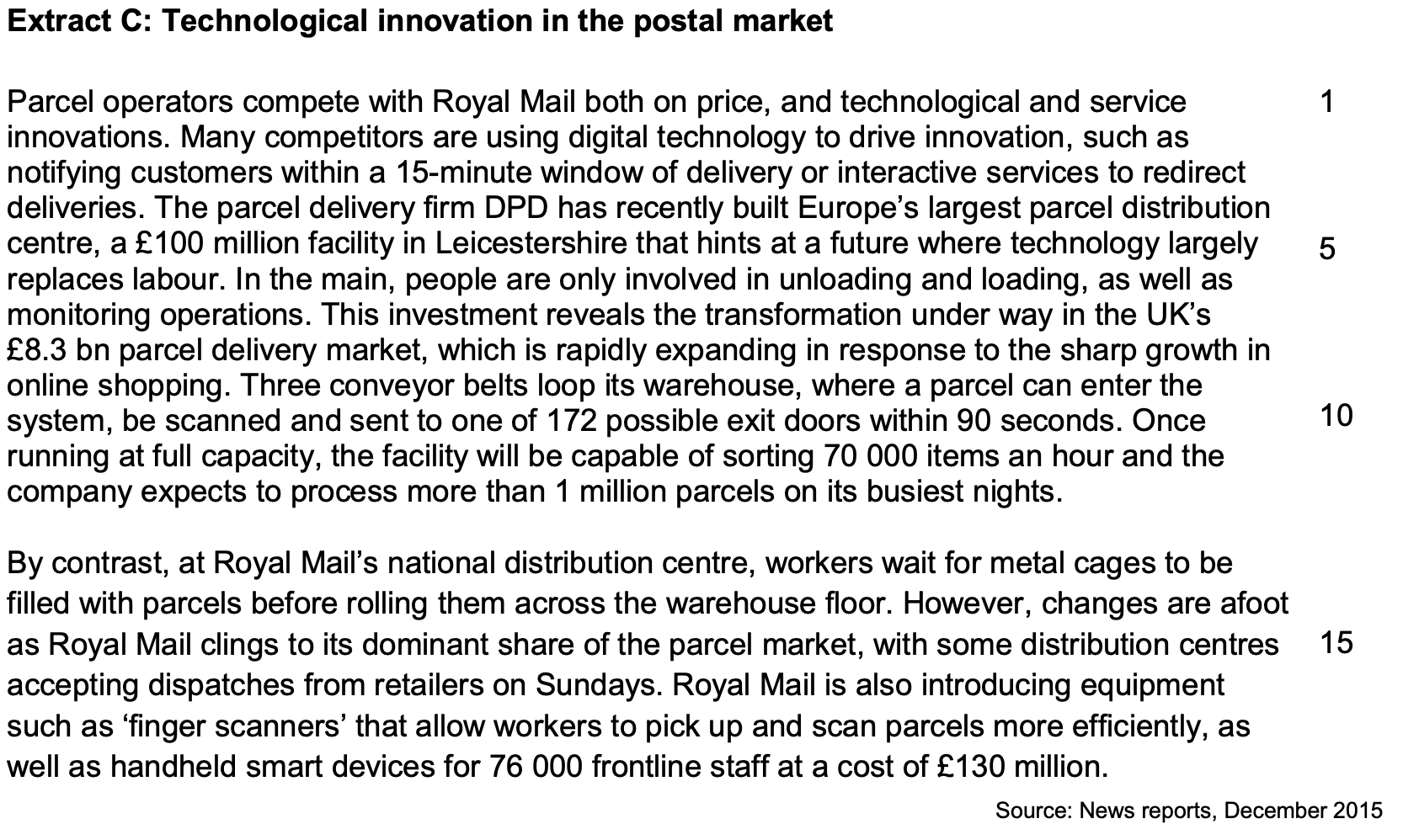
Assess the likely microeconomic impact of technological innovation in the UK parcel delivery market. [25 marks]
EN
AQA Master

Part 1: Introduction

Key Definitions

Technological Innovation – The introduction of new production methods, processes or products that improve efficiency or create new market opportunities.

Dynamic Efficiency – Improvements in productive efficiency over time, often driven by investment, research and development, and innovation, leading to lower long-run average costs and better products.

Context Framing

The UK parcel delivery market is valued at £8.3 billion and is expanding rapidly due to growth in online shopping. The extract highlights a transformational investment race, with firms like DPD investing £100 million in automation and Royal Mail spending £130 million on new devices for staff. This analysis will assess the microeconomic impacts on efficiency, costs, market structure, and consumer welfare.


Part 2: Analytical Sections

Section 1: Technological Innovation Driving Dynamic Efficiency & Competitive Advantage

Theory

Dynamic efficiency occurs when firms invest in innovation to lower their long-run average costs (LRAC) and improve product quality over time. It is a key feature of contestable and competitive markets where firms must innovate to survive.

Chain of Reasoning

Intense competition in the parcel market firms like DPD seek a competitive advantage not just on price but on service quality investment in automation (e.g., £100m distribution centre) represents process innovation this new capital increases the capital-to-labour ratio the marginal product of capital rises and unit handling costs fall the firm’s LRAC curve shifts downwards this grants DPD a temporary cost advantage, allowing it to offer lower prices or superior service (e.g., 15-minute delivery windows) this forces rivals like Royal Mail to respond with their own innovations (e.g., finger scanners) to maintain market share the market becomes more dynamically efficient over time.

Example from Extract

DPD’s automated centre can sort 70,000 items per hour and process over 1 million parcels on busy nights, a huge increase in capacity and speed compared to manual systems.

Diagram + Analysis

Diagram – Process Innovation (Shifting LRAC)

📊 See diagram: EconomicsHelp — Diagrams of Cost Curves

Axis labels: Vertical = Costs (£); Horizontal = Output (Q)

Key curves/lines: LRAC₁ (original), LRAC₂ (after innovation)

Shift/movement: LRAC₁ shifts down to LRAC₂ across all output levels.

New equilibrium: At any given output (e.g., Q₁), average cost falls from C₁ to C₂.

Economic outcome: DPD’s investment in automation is a process innovation that reduces its long-run average costs → LRAC shifts from LRAC₁ to LRAC₂ → this improves its productive potential and can lead to lower prices for consumers.

Evaluation

High fixed costs: The £100 million investment by DPD creates massive sunk costs. This high barrier to entry could paradoxically reduce contestability in the long run, protecting large incumbent firms from new competitors who cannot afford similar technology.

Time lags: The benefits of dynamic efficiency are long-term. In the short run, such investments can strain cash flow, as noted in the context where Royal Mail’s management may “find it harder… to find cash for investments”, potentially weakening its competitive response.


Section 2: Impact on Costs, Productive Efficiency & the Labour Market

Theory

Productive efficiency is achieved when production occurs at the lowest point on the average cost (AC) curve (min ATC). Technological innovation often displaces labour (labour-saving capital), altering the factor mix and the demand for different skill sets.

Chain of Reasoning

Automation technology (e.g., conveyor belts, automated sorting) replaces routine manual labour (the extract notes “technology largely replaces labour”) this increases the capital-to-labour ratio for firms variable costs per parcel fall as machines handle high volumes (70,000 items/hour) the firm’s short-run average total cost (SRATC) curve shifts downwards and its minimum efficient scale (MES) may increase the firm moves closer to productive efficiency. However, this reduces derived demand for low-skilled warehouse labour could increase structural unemployment in the absence of retraining this is a significant social cost, with the Communication Workers Union likely to “fight any redundancies”.

Example from Extract

At Royal Mail’s traditional centre, workers manually roll cages, a labour-intensive process. Their investment in ‘finger scanners’ aims to improve labour productivity, making existing workers more efficient rather than immediately replacing them.

Diagram + Analysis

Diagram – Shifts in Short-Run Cost Curves

📊 See diagram: EconomicsHelp — Diagrams of Cost Curves

Axis labels: Vertical = Costs (£); Horizontal = Output (Q)

Key curves/lines: SRATC₁ (original), SRATC₂ (post-innovation), MC₁, MC₂

Shift/movement: Both SRATC and MC shift downwards to SRATC₂ and MC₂.

New equilibrium: The cost of producing any level of output falls. The profit-maximising output (where MR=MC) occurs at a lower cost.

Economic outcome: Adoption of technology reduces both variable and average total costs → SRATC shifts from SRATC₁ to SRATC₂ → this increases productive efficiency, allowing firms to lower prices or increase profit margins.

Evaluation

Skill bias: The new technology increases demand for high-skilled workers (e.g., technicians, IT support) while reducing demand for low-skilled manual labour. This can exacerbate wage inequality within the economy, a significant microeconomic drawback.

Potential for higher quality: The impact isn’t solely on costs. Innovations like real-time tracking and re-direction services improve service quality and consumer utility, which may justify a price premium and lead to a net welfare gain beyond simple efficiency measures.


Section 3: Market Structure, Conduct & Performance

Theory

The structure of a market (number of firms, barriers to entry) influences firm conduct (pricing, investment) and ultimately economic performance (efficiency, innovation). The parcel market appears oligopolistic, with Royal Mail holding a “dominant share” and competing with other large firms like DPD.

Chain of Reasoning

The market is expanding (£8.3bn, growing with online shopping) attracts large-scale, game-changing investments from competitors like DPD this increases sunk costs and capital requirements, raising barriers to entry the market structure may become more concentrated. Firms engage in non-price competition through service innovation (e.g., delivery windows, Sunday collections) this can be beneficial for consumers, increasing choice and quality. However, Royal Mail’s need to “cling to” its share while funding a £130m tech upgrade shows profit may be squeezed this could limit future investment or lead to higher prices if the firm seeks to protect its profit margin.

Example from Extract

The extract explicitly states competition occurs on “technological and service innovations” as well as price, and contrasts DPD’s automated “future” with Royal Mail’s gradual adoption of new devices.

Diagram + Analysis

Diagram – Oligopolistic Interdependence (Kinked Demand Curve)

📊 See diagram: EconomicsHelp — Kinked Demand Curve

Axis labels: Vertical = Price/Cost (£); Horizontal = Quantity (Q)

Key curves/lines: Kinked AR (Demand) curve, MR curve with vertical discontinuity, MC₁, MC₂

Shift/movement: MC can shift within the MR discontinuity (from MC₁ to MC₂) without triggering a price change.

Economic outcome: In an oligopoly like parcels, firms may be reluctant to raise prices for fear of losing market share, but also reluctant to cut prices for fear of triggering a price war → this creates price rigidity. Competition is instead channelled into non-price areas like the technological innovation described in the extract.

Evaluation

Contestability vs. Concentration: While innovation is a sign of dynamic efficiency, the vast scale of investment required could make the market less contestable, shielding large incumbents. The net effect on long-term performance depends on whether the threat of entry remains credible.

Universal Service Obligation (USO): A key synoptic limitation is Royal Mail’s USO, which requires nationwide delivery six days a week. This imposes unique costs not faced by its competitors, potentially putting it at a disadvantage in the innovation race and distorting the level playing field.


Part 3: Final Judgement

In conclusion, the microeconomic impact of technological innovation in the parcel market is likely to be net positive, but with significant distributional consequences and risks. The strongest argument is the move towards dynamic and productive efficiency, as shown by DPD’s massive capacity gains and the industry-wide push for better service, which boosts consumer welfare and helps the market adapt to growing demand. The extract provides clear evidence of this transformative investment.

However, this judgement is heavily qualified. The benefits rely on the market remaining competitive enough to pass cost savings to consumers, rather than allowing increased concentration. Furthermore, the major counter-argument – the potential for technological unemployment and social resistance from unions – is substantial. Ultimately, the positive impact on efficiency and service quality will dominate provided that labour market policies (e.g., retraining) and competition policy are effective in mitigating the downsides. The evolution of this market will be a key case study in how oligopolistic firms balance innovation, cost, and competition.

Generated by EasyNomics, AI-generated, for reference only.

Page 1
Page 2
Page 3
Page 4
Page 5
Mark my essay: Assess the view that government intervention in the UK labour market is necessary to protect the interests of people who are working in the gig economy. [25 marks]
EN
AQA Essay Marker

EasyNomics — Examiner Report

Question: Assess the view that government intervention in the UK labour market is necessary to protect the interests of people who are working in the gig economy. • Paper 1 • Section A • 25 marks


1. Overall Mark and Level

Mark: 24/25 → Level 5

The response is well‑organised, demonstrates sound economic knowledge, applies extract data and real‑world examples consistently, develops clear logical chains of analysis, and offers supported evaluation throughout, culminating in a reasoned conclusion with specific proposals.


2. AO Breakdown

AOMaxAwardedRationale
AO144Sound knowledge of labour‑market concepts (minimum wage, MRP, occupational mobility, monopsony power) with accurate usage throughout.
AO244Excellent application: extract data woven in, plus own‑knowledge examples (Uber, Deliveroo, Bolt, Web MD) and well‑integrated diagrams.
AO377Multiple developed chains: minimum‑wage analysis, efficiency gains from reduced immobility, and limitations of mobility.
AO4109Supported evaluation distributed across paragraphs. One evaluative point is slightly asserted, but the majority are well‑supported.
Total2524Within Level 5 range ✓

3. Strengths

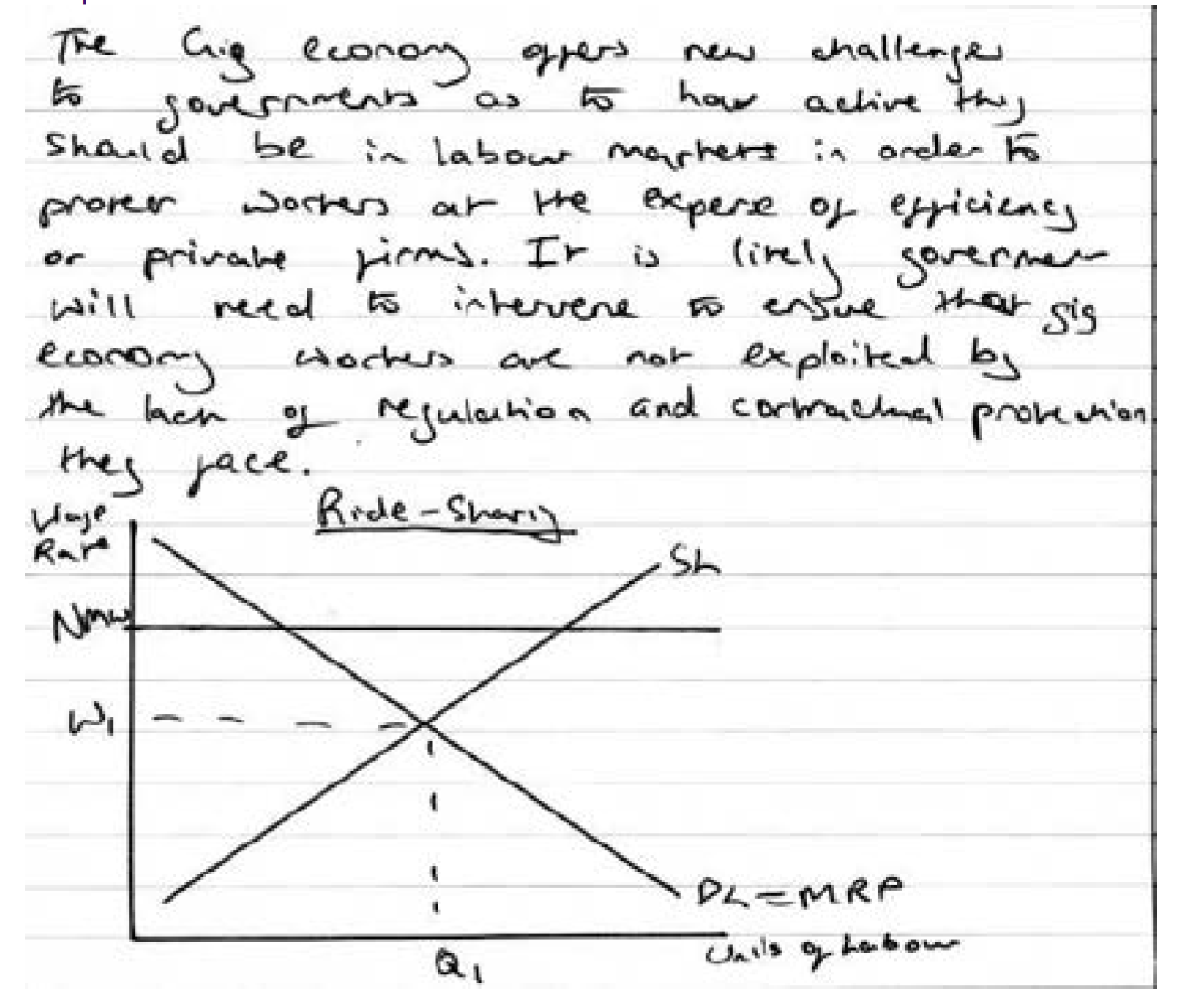
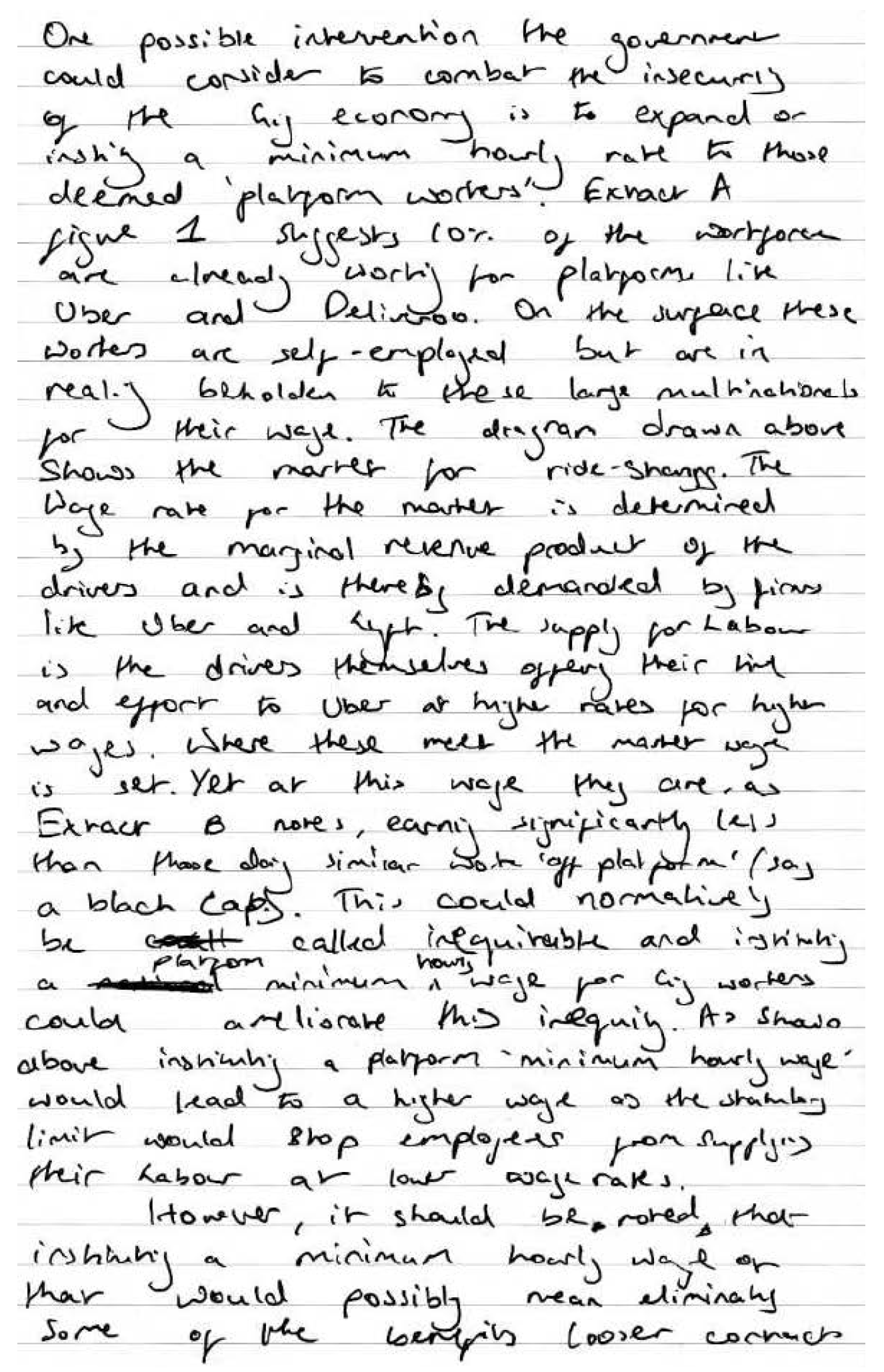
Application of extract data: “Extract A figure 1 suggests 10% of the workforce are already working for platforms like Uber and Deliveroo” → effectively uses the provided data to contextualise the scale of the gig economy.

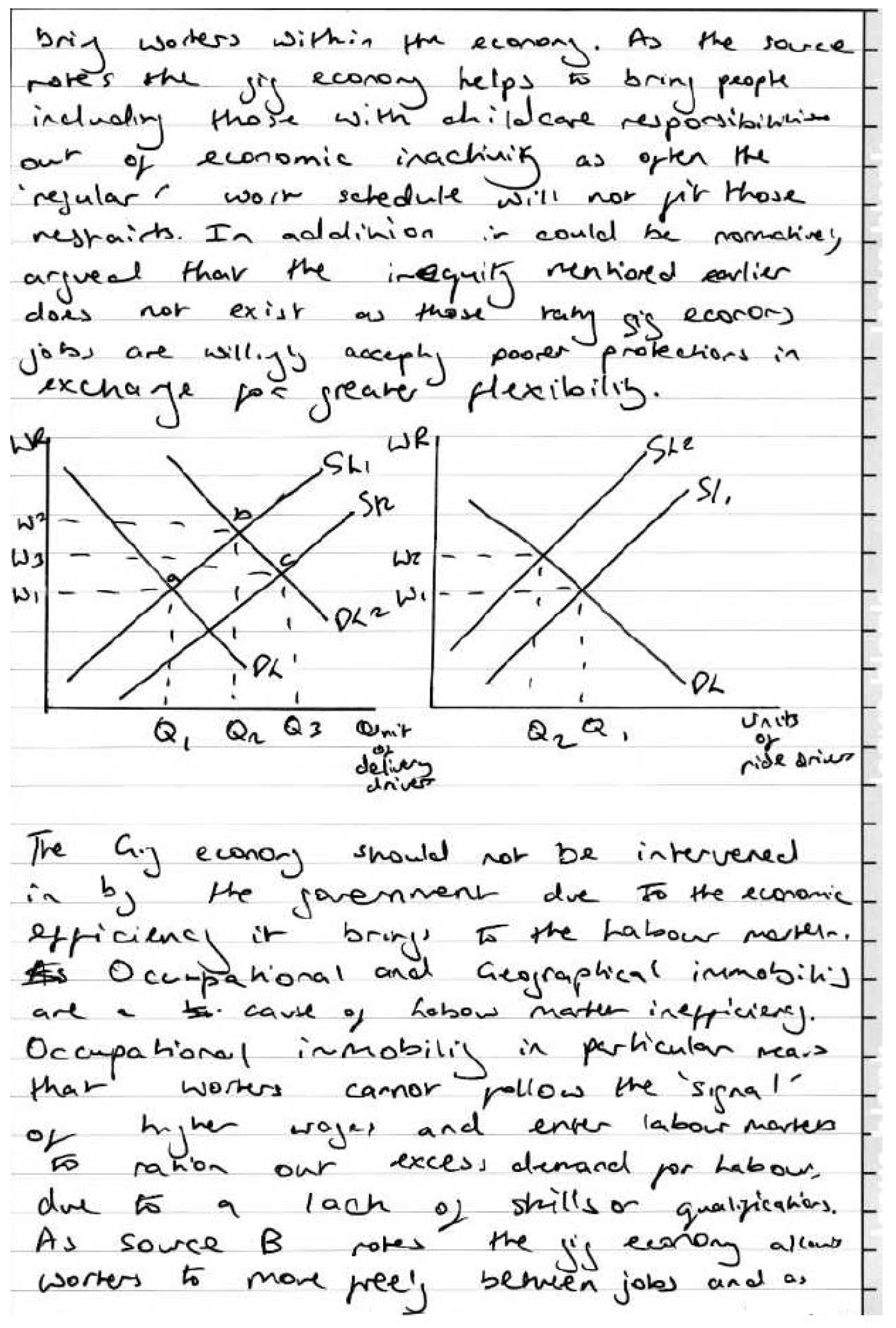
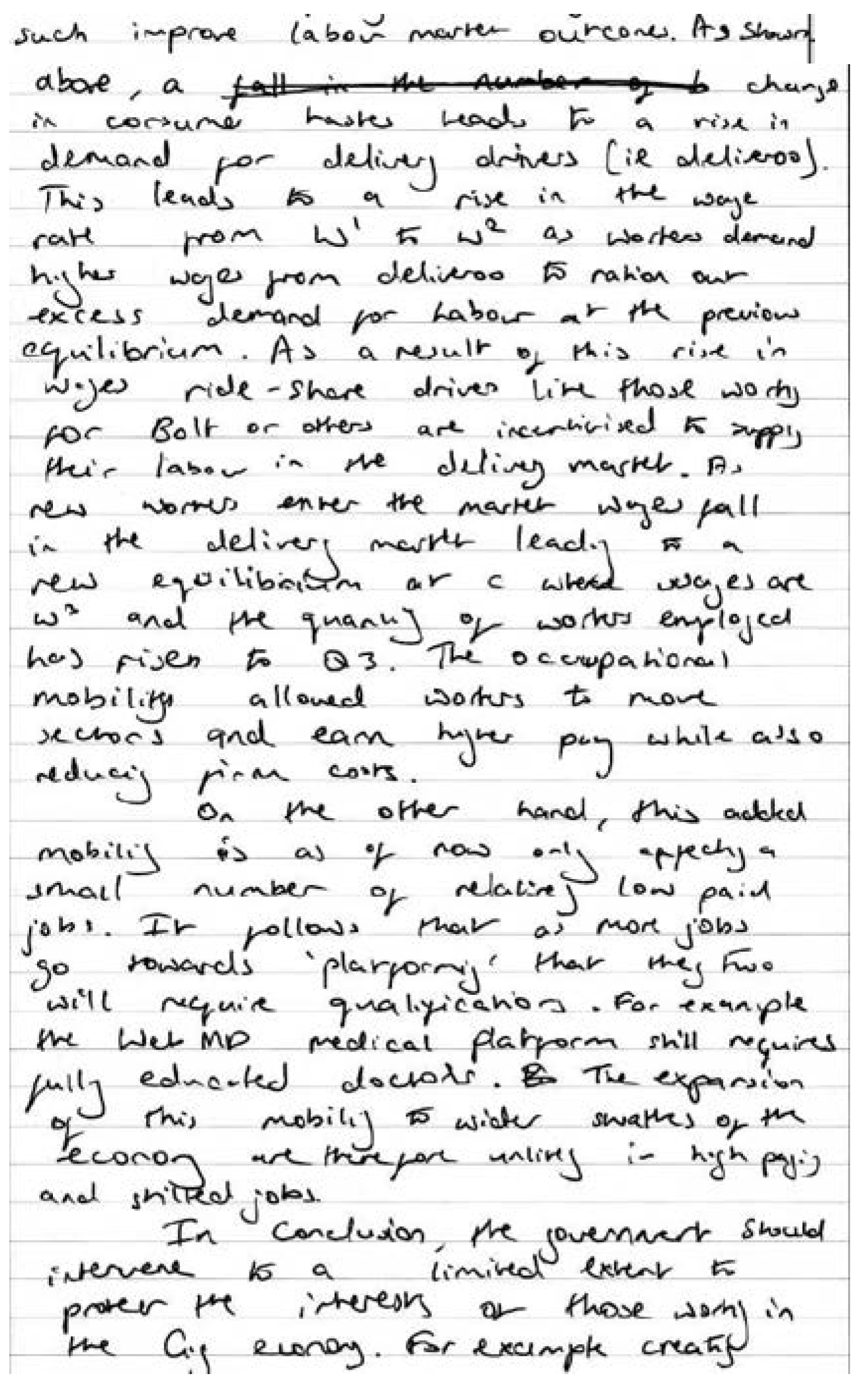
Clear analytical chain with diagram integration: “As shown above, a change in costume bases leads to a rise in demand for delivery drivers… This leads to a rise in the wage rate from W¹ to W²” → traces cause‑effect with explicit reference to a labelled diagram.

Supported evaluation with real‑world examples: “On the other hand, this added mobility is as of now only affects a small number of relatively low paid jobs… For example the Web MD medical platform still requires fully educated doctors” → provides a limitation backed by a specific example.


4. Path to the Next Level

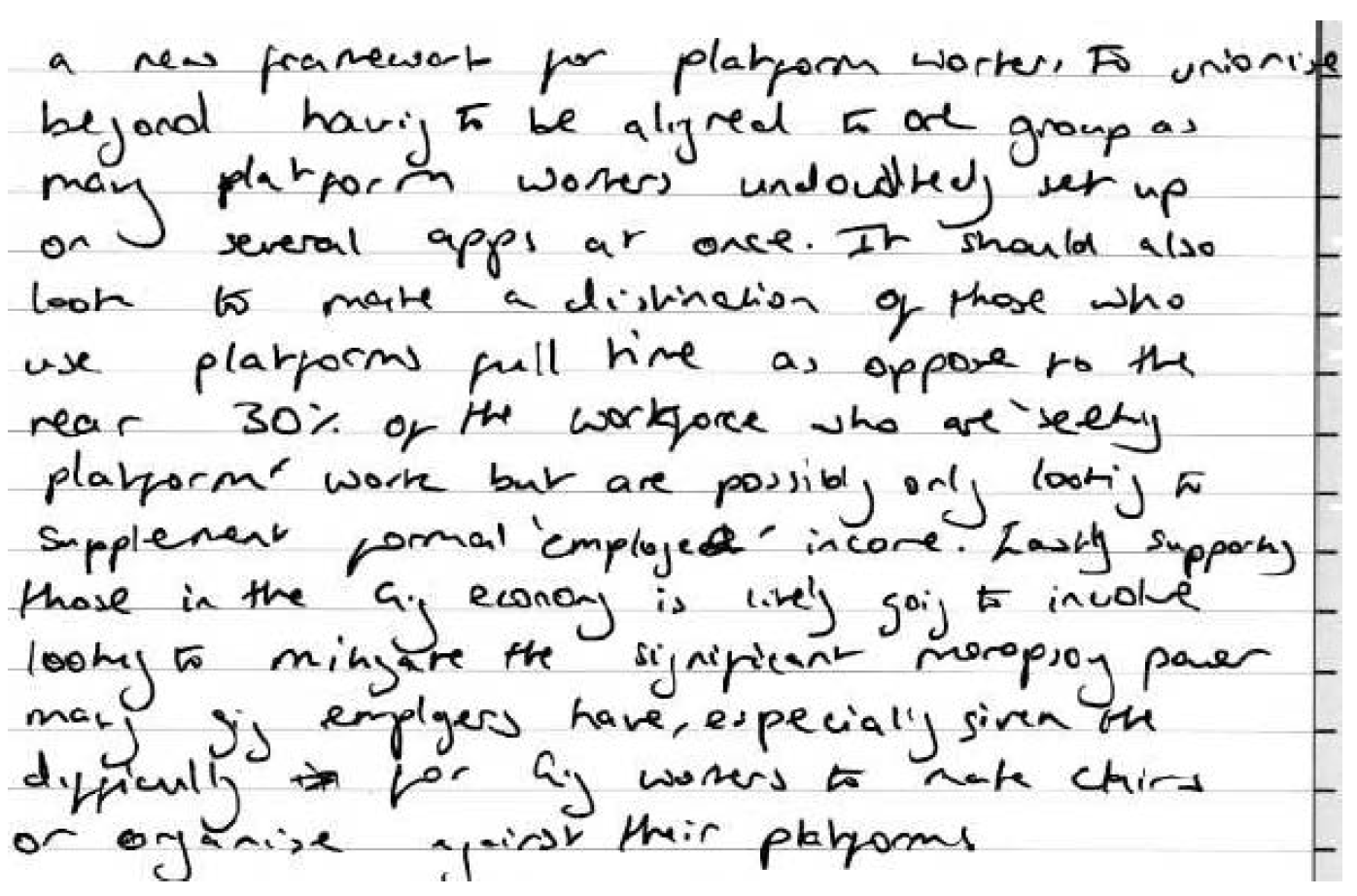
Deepen the evaluation of proposed interventions: The conclusion suggests “a new framework for platform workers to unionise” and “mitigate the significant monopoly power” but does not explain how these measures would work or their potential drawbacks. To reach 25/25, briefly analyse the mechanism and possible trade‑offs of each proposal.

Tighten phrasing in one evaluative point: The statement “instig a minimum hourly wage on it would possibly mean eliminating some of the benefits looser corners” is vague. Specifying which benefits (e.g., flexibility for workers, lower costs for platforms) and why they might be lost would strengthen support.

Expand on the monopsony power point: The essay notes monopoly power but does not develop how it leads to exploitation (e.g., wage‑setting power, lack of bargaining). A sentence linking monopsony to lower wages and the need for intervention would add analytical depth.


AQA Examiner Report — Official Verification

Level 5 response. This is a high value response. This is a well organised response, and the student demonstrates sound knowledge and understanding. There is good application of relevant economics to the context and very effective use of the data in the extracts to support arguments. There is well-focused analysis with clear, logical chains of reasoning. There is supported evaluation throughout the response and in the conclusion.

The student begins with a good introduction regarding the ‘gig’ economy, and a tentative evaluative comment suggesting it is likely that the government will need to intervene. The student includes a labour market diagram illustrating a minimum wage for ‘ridesharing workers’. The subsequent analysis effectively combines both the diagram and data from the extracts, plus some evaluative comments, to support the argument for intervention.

Next, the student includes two labour market diagrams for ‘delivery drivers’ and ‘ride drivers’. In the analysis that follows they suggest that government intervention may not be required as the gig economy allows for more labour-market efficiency and improved mobility of labour. The diagrams and data from the extracts are successfully integrated into the response.

Finally, the student offers their overall judgement suggesting that ‘…the government should intervene to a limited extent…’ They suggest how and why, and the evaluation is fully supported by the conclusion itself and the earlier analysis and data. Overall this is a sophisticated response, it is written completely in context, and properly answers the question set.

Official AQA Mark: 23/25

Generated by EasyNomics, AI-generated, for reference only.
Born from a passion for economics.

2024 · Dulwich College

A-Level Economics students had nowhere to turn for reliable, exam-board-specific guidance. Resources were fragmented and rarely aligned to what examiners actually reward. So we brought together high-achievers, LSE economists, and leading teachers to build something purpose-specific: not another chatbot, but a tool trained on real past papers and refined with every syllabus change.

Economics is how I make sense of the world, it has been since I was fifteen. I started EasyNomics because I believe everyone deserves to access that clarity. We’re here to make economics easier and more accessible for every student.

Etienne Chen, Founder & CEO

Built by people who've been there.

Students, engineers, economists, and leading A-Level teachers, all committed to keeping EasyNomics ahead of every syllabus change.

Etienne Chen

Etienne Chen

Founder & CEO
BSc Economics, Dulwich College OA. Ulink College of Shanghai alumni. UKMT Gold & AIME qualifier, John Locke Economics shortlist. NEC Gold medallist. IEO 5th nationally. Built the AQA product from scratch, designing the AI logic behind Essay Planner and Examiner AI. Designed and built the official website.
Jessie Zhu

Jessie Zhu

Co-Founder & CTO
Founder of Createch Intelligence. Full-stack engineer specialising in Swift, TypeScript & Python. Engineered the EasyNomics platform end-to-end, building the custom frontend, backend and payment system that power the product.
Eric Wang

Eric Wang

CPO & CIE Specialist Advisor
BSc Economics, LSE. Ulink College of Shanghai alumni. NEC 4th globally, IEO 5th nationally. 100+ hours tutoring economics with 54%+ student improvement. Leading product strategy, market research, and CIE content quality.
Alaia Jiang

Alaia Jiang

China CMO
BSc Economics, UCL. Guanghua Cambridge International School alumni
Mohid Sajjad

Mohid Sajjad

UK CMO
BSc Economics, Manchester. Ark Acton Academy alumni, Upreach Associate
Rex Hu

Rex Hu

China Marketing Manager
BSc Economics, UCL. Ulink College of Shanghai alumni
Eureka Liu

Eureka Liu

UK Marketing Manager
BSc Economics, Manchester. Concord College alumni
Enoch Yiu

Enoch Yiu

AQA Specialist Advisor
BSc Philosophy, Politics and Economics, Dulwich College OA
Tolly Chen

Tolly Chen

AQA Specialist Advisor
BSc Political Economy, Dulwich College OA
Carl Liu

Carl Liu

CIE Specialist Advisor
BSc Management, LSE
Claire Zhou

Claire Zhou

CIE Specialist Advisor
BSc Economics, LSE. Ulink College of Shanghai alumni

Rated 4.9 out of 5.

Real, unedited reviews from A-Level Economics students. Worth every penny.
All reviews are from verified EasyNomics users, confirmed via account activity.

4.9/5 ★★★★★
Average Rating
24/25
AI Marker vs 23/25 Human Examiner
95%
Saw Grade Improvement
8+
Schools Worldwide
“Was stuck in grade B due to lack of understanding of the mark scheme and underdeveloped logic chains. EasyNomics was amazing for compiling my notes into essay-ready logic chains, along with suggestions of real-world case studies that are suitable for each topic. Highly recommend for anyone that struggles to obtain the top grades.”
Rulin
Rulin
Altrincham Grammar School for Boys
“The marking tool caught things my teacher didn’t even mention. It told me my KAA paragraphs were too short and showed me exactly what was missing. Really specific feedback.”
Egor C.
Egor C.
University of Oxford
“An amazing tool that helped improve my understanding of economics and prepare me for my A Level exam!”
Tobias P.
Tobias P.
University of Cambridge
“Used it the night before my mock and actually understood how to link my analysis back to the question. My teacher said it was the best essay I’d ever written.”
Aaron M.
Aaron M.
LSE
“I was the first person to use EasyNomics, back when it was still being built. Watching it go from a prototype to something that genuinely helps you plan and mark essays has been incredible. It understood the AQA spec better than most revision guides I’d tried.”
Harry Zhu
Harry Z.
UCL
“EasyNomics completely changed how I revised. Instead of spending an hour planning a 25-marker from scratch, I’d get a solid structure in minutes. The AI Examiner also caught weaknesses in my evaluation that I’d been repeating across essays without realising. When you’re juggling four A-Levels, that efficiency is everything.”
Michael M.
Michael M.
A*A*A*A* (Maths, FM, Econ, CS)
“I went from getting Cs on my essays to a solid A. The essay planner showed me exactly how to structure my evaluation paragraphs, which is where I was losing most of my marks.”
Khanh T.
Khanh T.
Dulwich College
“I started Year 12 not understanding concepts, forgetting definitions and scoring low marks on essays. I considered dropping Economics before discovering Easynomics. Now my revision was incredibly more effective and efficient, helping me learn key ideas faster than ever before. It saved my predicted grades helping me get my dream University offers.”
David A.
David A.
Dulwich College
“I started A-Level Economics struggling to achieve half marks. Now I’m consistently hitting the highest level in all of my essays.”
Aashish Dubay
Aashish D.
Queen Mary’s Grammar School
“It actually knows the CIE syllabus. I asked ChatGPT the same question and got a generic answer. EasyNomics gave me the exact structure for a 20-mark Paper 4 essay.”
Eureka L.
Eureka L.
Concord College
“I like debating AI, and EasyNomics is great to debate Economics with. It really helps you consider both sides of an argument and think more deeply about your evaluation.”
Harsh D.
Harsh D.
Mahatma Gandhi Institute
“Was stuck in grade B due to lack of understanding of the mark scheme and underdeveloped logic chains. EasyNomics was amazing for compiling my notes into essay-ready logic chains, along with suggestions of real-world case studies that are suitable for each topic. Highly recommend for anyone that struggles to obtain the top grades.”
Rulin
Rulin
Altrincham Grammar School for Boys
“The marking tool caught things my teacher didn’t even mention. It told me my KAA paragraphs were too short and showed me exactly what was missing. Really specific feedback.”
Egor C.
Egor C.
University of Oxford
“An amazing tool that helped improve my understanding of economics and prepare me for my A Level exam!”
Tobias P.
Tobias P.
University of Cambridge
“Used it the night before my mock and actually understood how to link my analysis back to the question. My teacher said it was the best essay I’d ever written.”
Aaron M.
Aaron M.
LSE
“I was the first person to use EasyNomics, back when it was still being built. Watching it go from a prototype to something that genuinely helps you plan and mark essays has been incredible. It understood the AQA spec better than most revision guides I’d tried.”
Harry Zhu
Harry Z.
UCL
“EasyNomics completely changed how I revised. Instead of spending an hour planning a 25-marker from scratch, I’d get a solid structure in minutes. The AI Examiner also caught weaknesses in my evaluation that I’d been repeating across essays without realising. When you’re juggling four A-Levels, that efficiency is everything.”
Michael M.
Michael M.
A*A*A*A* (Maths, FM, Econ, CS)
“I went from getting Cs on my essays to a solid A. The essay planner showed me exactly how to structure my evaluation paragraphs, which is where I was losing most of my marks.”
Khanh T.
Khanh T.
Dulwich College
“I started Year 12 not understanding concepts, forgetting definitions and scoring low marks on essays. I considered dropping Economics before discovering Easynomics. Now my revision was incredibly more effective and efficient, helping me learn key ideas faster than ever before. It saved my predicted grades helping me get my dream University offers.”
David A.
David A.
Dulwich College
“I started A-Level Economics struggling to achieve half marks. Now I’m consistently hitting the highest level in all of my essays.”
Aashish Dubay
Aashish D.
Queen Mary’s Grammar School
“It actually knows the CIE syllabus. I asked ChatGPT the same question and got a generic answer. EasyNomics gave me the exact structure for a 20-mark Paper 4 essay.”
Eureka L.
Eureka L.
Concord College
“I like debating AI, and EasyNomics is great to debate Economics with. It really helps you consider both sides of an argument and think more deeply about your evaluation.”
Harsh D.
Harsh D.
Mahatma Gandhi Institute

Frequently asked questions.

Everything you need to know about EasyNomics and how it supports your A-Level Economics studies.

EasyNomics offers two dedicated tools, each built from the ground up for its exam board. EasyNomics CIE covers Cambridge International 9708 (2026 to 2028), while EasyNomics AQA covers AQA A-Level Papers 1, 2 & 3. They run as separate products so every response matches your board’s specific marking scheme, command words, and assessment objectives.

CIE and AQA have different paper structures, mark tariffs, and examiner expectations. A one-size-fits-all tool would compromise accuracy. By building two independent AI tutors, each trained on its own past papers, mark schemes, and examiner reports, we ensure the guidance you receive is precisely aligned to how your essays are actually marked.

The real comparison isn’t ChatGPT, it’s a private A-Level Economics tutor. EasyNomics delivers the same service: structured essay planning, personalised feedback on your writing, and guidance tailored to your exam board. But it goes further. Unlike a tutor, EasyNomics is available 24/7, gives feedback with zero marking bias (strictly against official mark schemes), and adapts to you over time. You can ask any question without feeling embarrassed, revisit concepts as many times as you need, and get detailed criterion-by-criterion feedback on every essay you submit. It’s built from official syllabuses, real past papers, examiner reports, and locked essay structures (AO1, AO2, AO3), not generic AI responses. All at a fraction of a tutor’s cost.

EasyNomics supports AQA A-Level Economics (7136) and CIE A-Level Economics (9708) with dedicated, syllabus-specific tools for each board. AQA: Data response (Section A) and essays (Section B) for Papers 1, 2 & 3 (15 and 25 marks), including synoptic questions. CIE: Data response and essay questions for Papers 2 & 4 (8, 12, and 20 marks), including linked (a)/(b) parts. Both products auto-detect question format and apply the correct structure. You can also submit your own essays for AI marking, or ask any general economics question and receive a syllabus-aligned explanation.

EasyNomics provides precise diagram descriptions, including axis labels, curve shifts, and equilibrium changes, drawn from an approved diagram bank (AD/AS, Demand & Supply, Labour market, PPC, and more). You draw the diagram; EasyNomics tells you exactly what it should look like. Every diagram description also includes a clickable reference link to a verified learning resource (such as EconomicsHelp or tutor2u), so you can see a real example of the diagram and deepen your understanding.

EasyNomics was founded by Etienne, and built by a team of high-achieving A-Level alumni, LSE economics students, and experienced educators. Etienne leads product design for both the AQA and CIE editions, with exam-specific guidance from Eric, Claire, Carl, Alaia, Enoch and Tolly. Rex and Alaia drive marketing and growth in China, while Eureka leads marketing in the UK. All development and engineering is carried out by Jessie Zhu at Createch Intelligence. The team actively updates the system to reflect the latest syllabus changes as soon as they are released.

Learning economics has never been this easy.

Examiner-approved structures. Personalised AI feedback. Real improvement at a fraction of a tutor’s cost. That’s why it’s called EasyNomics.

From £1.15/week · 3-day free trial, no card needed

Start free trial
Secure payments via Stripe · No auto-renewal